Case study · Personal project · November 2026
Mogette
A week of meals, built from the week’s deals.
I live alone with a cat and do my shopping once a week, at a Lidl in Bordeaux. Mogette reads the week’s offers, checks them against other chains, plans my lunches and dinners around the real bargains, activates the coupons that help, counts what I already have at home and writes the list by aisle. It runs on my Android phone as a web app.


Try it
This is the real app, with the Lidl offers of the week of 12 November 2026 frozen inside. Receipts and coupons are invented. Nothing you do leaves your browser. The app is in French.
Things to try
- Pick a household and a shopping day, then “C’est parti”.
- In Ma semaine, “Générer avec mes recettes”. Change the number of days or the way you cook, then generate again.
- Tap a dish: its real cost, its nutrients, the Monsieur Cuisine version.
- The tag at the top right opens deals and coupons. Tap a deal to see the other chains.
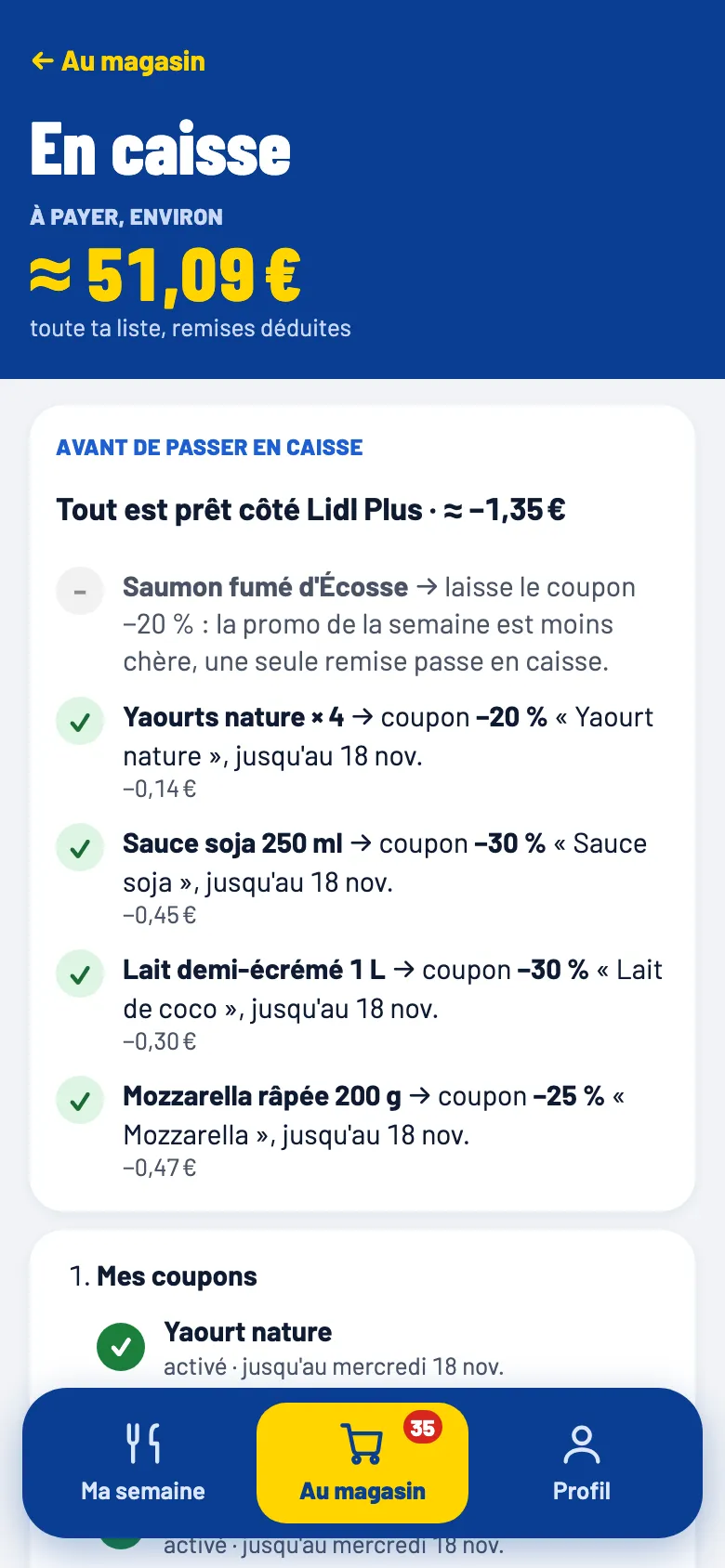
- In Au magasin: tick items, “J’ai déjà”, then “Je passe en caisse”.
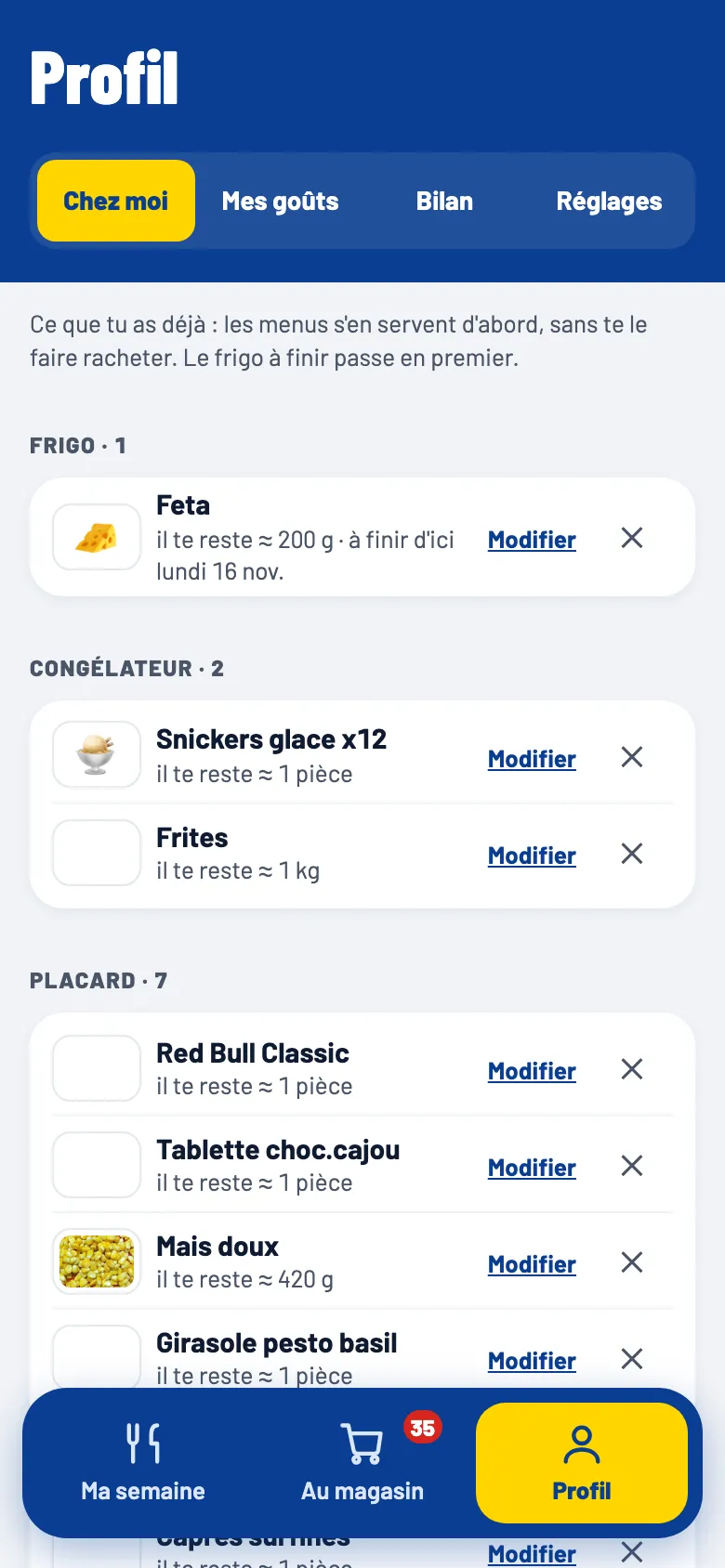
- Profil › Chez moi: put the last receipt into the stock.
The Mogette assistant (the AI) and the linked accounts (Lidl Plus, Home Assistant) are not connected in the demo.
What it replaces
The Lidl Plus app shows about fifty offers a week. Each one says how much it takes off, never whether it is cheap.
In the week of 5 November, 26 of those offers were food. Only 8 could be compared with another chain using open data. Coupons give no price at all, and they do not stack with an in-store offer: one discount per product at the till.
My two receipts told the rest. On 2 November I paid 55.82 euros, and about 19 euros of it went to energy drinks, ice creams and sweets that no plan had asked for. I was saving 1.60 euros on deals and spending more than ten times that on impulse.
In: four sources
- Lidl
- Lidl Plus offers and my coupons, the printed leaflet, the in-store pages of lidl.fr
- Market prices
- FranceAgriMer: average supermarket price of about 140 fresh products, every week
- Other chains
- Open Prices: shelf prices recorded by people, per chain
- Me
- My receipts, my tastes, what I already have at home
Mogette
A PHP server on my hosting, an installable web app in plain JavaScript. The assistant Mogette, on Claude, writes new dishes from the week’s picks.
Out
- The week’s meals, lunch and dinner
- A list sorted by aisle, that works offline
- The useful coupons, activated in my Lidl Plus account
- Bargains to freeze, flagged on my phone the evening before
- My food stock, shared with Grocy in Mogi, my Home Assistant system
- The recipes, sent to my Monsieur Cuisine robot
Five decisions
Most of the work went into what the app is allowed to claim, and what it tries to make cheaper.
-
One honest verdict per deal
Cheaper than elsewhere, discount announced by Lidl only, or no comparison possible. A deal is compared with the cheapest chain that has at least two price records for the same product, not with an average that flatters it.
-
Make the meal cheaper, not the discount bigger
The first algorithm added up savings: salmon pasta at 30 percent off (2.59 euros a portion) beat a dahl that was never on offer (0.87). It now picks dishes by what a portion really costs, whole packs and pantry included.
-
One discount at the till
A coupon and an offer do not add up. The app keeps the better one, says when a coupon is useless, and activates the useful ones by itself.
-
What I already have comes first
The receipt goes into the stock, the fridge to finish comes first in the menu, and nothing I have goes back on the list.
-
One savings number, everywhere
Lidl’s normal price minus the price paid, on the packs actually bought. The home screen, the recipe and the list used to show three different figures for the same week.
Contents
The app follows a week of shopping. One chapter per moment.
The week’s menu
How many days, how I cook, what matters. The real cost of a portion, the Mogette assistant and the Monsieur Cuisine robot.
Deals and coupons
Three sources of offers, one verdict per deal, discounts on a selection, coupon or offer, loyalty points.
In the shop
The list by aisle, bargains to freeze, the till screen.
At home
The stock filled from the receipt, shared with Home Assistant, my tastes, the budget and what the app learns.
Under the hood
Data sources, the 5:00 refresh, linked accounts, the method and what the app refuses to do.
Designer’s notes
A discount is a number the shop chooses to show. The useful number was the cost of a plate.
Once the app counted what a portion really costs, most of the design followed: which deals deserve a place, which coupon wins, when to say nothing can be compared. Saying “I don’t know” on most deals made the others believable.
I bring the same question to any product that shows prices, scores or recommendations: what is the number the person actually lives with?